Figuring out how to learn SEO, starting with what SEO is, can seem like a very daunting task. It is a complex subject and the industry is full of misinformation. But with a little time, effort and the right roadmap, it is something anyone can learn.
Here is the roadmap we will cover in this guide:
So let's get started.
Learn the fundamentals of SEO
Assuming you are already familiar with the basics of SEO, we start by presenting some important concepts. You need to understand how search engines work and the four main aspects of SEO.
How search engines work
Search engines work by finding content and storing it in a large database known as an index. Think of it as a library, but a library that stores web pages instead of books. When you run a search, the search engine finds and returns matching results from the index. These complex processes, known as search algorithms, rank the results.
So when you search for something on Google, you are not searching the whole web. You are only searching the pages in Google's index.
This matters for one simple reason:
If you are not in Google's index, you cannot rank in its search results. To appear in those results, either Google has to find you on its own or you have to get yourself listed in it.

Google builds its index from two main sources:
- Sitemaps – A sitemap is a file that lists all the important pages on your website that you want search engines to find. You can submit your sitemap to Google to tell it that your pages exist.
- Links from known pages – Google already has billions of pages in its index. If you get a link from one of those pages, Google can “follow” the link to discover your page.
Google can discover new pages of your website by “following” links to them from known pages. But it can also do the reverse. It can discover new third-party websites by “following” links from your site.
For example, let's say Google already has your blog's home page in its index. If you add an internal link from there to a new blog post, Google can “follow” that link to find the post.
Comment
You can ask Konet to submit all the pages of your website to Google, Bing and any other search engine you like, right away!
Keyword research
Keyword research is the process of finding out what your customers are searching for. It matters because people will not discover you if they are not searching for the keywords you are targeting.
Unfortunately, Google does not exactly make this information easy to access. But there are several ways to uncover it. One way to find keywords is with a keyword research tool. To use one, enter one or a few broad topics related to your industry, hit search and then go to one of the keyword reports. You will see the monthly search volume of each keyword and a few other SEO metrics.
Of course, the numbers shown by keyword research tools are estimates. That is because only the search engine itself knows the real figures. The tools measure the traffic of the websites that share data with them and use it to calculate traffic figures for each keyword. Although the numbers are not perfectly accurate, they are a very good indicator of how much traffic you could get if you ranked at the top.
Comment
Want to know the keywords of your website and your competitors? At Konet we can prepare a report for you with all the data you need.
On-page SEO
On-page SEO is where you optimize the content of each individual page to rank higher in search engines. It largely revolves around understanding whether you are giving “searchers” (the people running the searches) what they are looking for. This process is known as optimizing for search intent.
For example, if we look at the top results for the keyword “best keyboards 2023”, we see that they are all blog posts comparing top picks:

On the one hand, this tells us that although “searchers” want to buy a keyboard, they are still weighing their options and are not quite ready to buy. On the other hand, it tells us that these blog posts do better SEO than the online stores. As a result, it would be hard to rank an e-commerce product page for this query. It is not what search engine users want.
Comment
The fact that you found this article is the result of on-page SEO. You can ask Konet to help you with the on-page SEO of your website.
Link building
Link building is the process of getting backlinks to your website from other websites. It matters because backlinks are one of Google's top three ranking factors.
This is probably why there is a clear correlation between linking websites and organic traffic:

However, not all links are equal. Links from relevant, high-quality websites usually move the needle more than links from irrelevant, low-quality ones. In other words, if your website is about tourism, a link from a website about tourist accommodation will probably have a bigger positive effect on your rankings than a link from a website about furniture.
Comment
Link building is demanding work. Make sure you turn to real specialists so that you do not lose money and damage your rankings.
Technical SEO
Technical SEO makes sure that search engines like Google can find, crawl and index your content. If they cannot do all three, your pages are unlikely to appear in search results.
Let's look at these three things in more detail.
- Discovery – Google first needs to know that your page exists and where to find it.
- Crawling – Google then needs permission to crawl your page. This is where a computer program downloads the page's content.
- Indexing – Google then needs permission to add your page to its index.
You can solve the first part of the process by making sure your page is linked from other known pages on your website and that you have created a sitemap and submitted it.
As for crawling and indexing, you need to make sure you are not blocking Google from doing either of these things. This is done with a file called robots.txt (crawling) and a meta tag called meta robots (indexing).
Comment
Technical SEO is a very important part of your online presence. Make sure all your pages can be indexed. If you do not know how, ask us.
Put your knowledge into practice
Now that we have covered the theory, it is time to put that knowledge into practice. This, however, is the hard part.
For example, when we started working on SEO in 2010, we built a website that appeared at the top of the results. It met every requirement for a good position in the SERPs (Search Engine Results Pages). We had done our keyword research and worked on link building. At the same time, through technical SEO, we were sure that every search engine could access our website without any obstacles.
Below is our website as it looked in October 2012. This version of our website ranked very well on Google.

Over time, however, Google changed its algorithm and we dropped lower in the search results.
Looking for the cause, we realized that we had not worked enough on on-page SEO. We had to change our approach so that we could create higher-quality content.
This, combined with continuous improvement of the other factors, helped our website recover and return to high positions in search.
Comment
The basic parts of SEO stay the same. The specifics, though, the ones that make the difference, change several times a year. If you do not follow them constantly, you are likely to lose ranking positions.
Deepen your SEO knowledge
The ancient Greek saying “I grow old ever learning” can apply to your SEO knowledge today.
All Round SEO
SEO has many aspects and it is a very broad subject. It is hard (or rather impossible) for anyone to know every aspect of it. But you can read and experiment to gain more knowledge about it.
If you want to apply your SEO knowledge to your own website, or to rank other people's websites higher, the “all round” path is the one to choose. It will help you a lot, since you will work on every aspect of SEO.
T-Shaped SEO
If, however, you want to become an SEO professional, you can also follow the “t-shaped” path. The idea of “t-shaped SEO” is to go very deep into one area of SEO so that you become an expert in it.
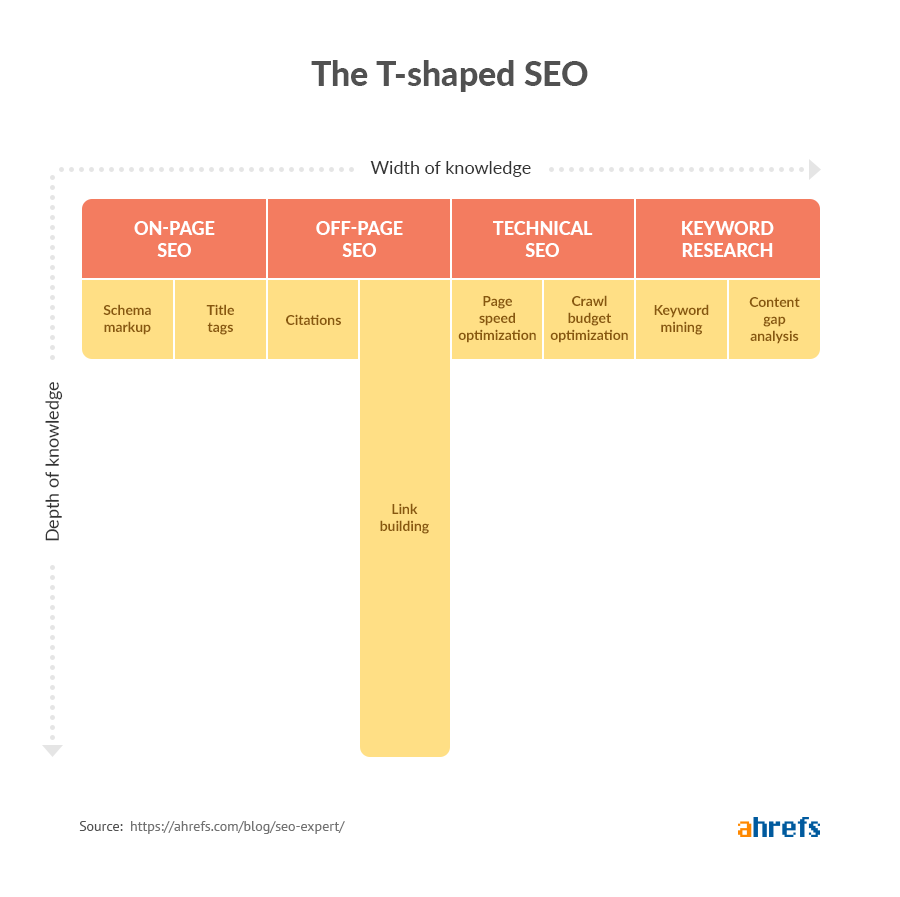
Being a “t-shaped SEO” means having broad knowledge of everything in SEO while specializing in one particular area. The area you choose to specialize in should be the one you are best at and enjoy the most.
Some choose link building to go deep, as shown in the image above. Others go deep into technical SEO, others into keyword research, and there are also those who enjoy competition analysis. SEO has many aspects, so there are many opportunities to go deep.
Becoming an expert in one area is a good idea if you are learning SEO to practice it professionally. But if you want to rank your clients' websites higher, it is probably better to keep things slightly broader and stay within one of the four main aspects of SEO.
Either way, you should always test what you learn on your own website. That is where the real learning happens.
Comment
To become a “T-shaped SEO”, you first need to become an “all round SEO”
Keep your finger on the pulse
Despite what many people say, the fundamentals of SEO barely change. But the small things change all the time. There are Google updates several times a year, changes in how search engines handle aspects of technical SEO, smart people coming up with new tactics, and so on.
With that in mind, while you should not spend all day every day reading SEO news, it is important to keep your finger on the pulse.
Comment
Sharing is caring. So we will share a lot of information here
Here are a few ways to do it:
Attend SEO conferences
SEO is a big industry with big conferences. The large conferences, for example, attract many thousands of attendees. There are also many smaller conferences around the world. These are all places where like-minded SEO people share knowledge and tactics, so there is a lot to learn by attending.
Even if you cannot attend, you can easily read their proceedings or watch videos about them.
Read SEO news
Almost every day there is news from the SEO industry. It may be a change in the search engines, a case study, some new research and so on. Even if you are not an SEO professional, reading the news can give you a lot of information about SEO.

Read SEO blogs
Like the one you are reading, where we often publish original ideas, processes and studies. There are a great many SEO blogs worth reading. They offer valuable information for free that will help you get better at SEO.
If you are a beginner…
Watch SEO videos or listen to podcasts
Although watching videos and listening to podcasts can generally be a waste of time, they will be useful if you are just starting out with SEO. With videos in particular, you can get a lot of information in a short time. They will give you a general understanding of SEO. To go deeper, though, you will need to turn to articles, news and above all practice.
If you are more advanced…
Read papers and conference proceedings
Strange as it may seem, SEO is studied scientifically. There are universities abroad that work on it and researchers publish papers very often. You can also find studies on SEO in the proceedings of scientific conferences (which are different from industry conferences). In these studies you will see the technical side of SEO explored in great depth.
Comment
Here is a “secret” that goes against the Greek know-it-all mentality. Whatever you do, always check online what is happening in your field around the world. This will help you a great deal, as you will follow the latest developments and keep expanding your knowledge and broadening your horizons. Let's not forget that in many fields other countries are ahead of us.
Teach others what you know
This may seem unthinkable, given that this way you are helping the competition. Helping others by teaching will let you spread knowledge. In the long run this is in everyone's interest.
Teaching others also helps you retain and absorb knowledge. As others learn from you, you will consolidate the knowledge you share.
At the same time, teaching will establish you as an expert. If people see that you know a subject well, they will trust you and contact you more often for guidance.
However, there is a very important point we need to make here.
Do not try to teach SEO to others unless one of the following is true:
- You have researched thoroughly and understand what you are teaching.
- You are teaching something based on personal experience and testing (and you have made that clear).
The last thing you want to do is add more misinformation to an industry that is already full of it.
Comment
Although we have no shortage of sages and teachers, the IT sector in Greece lags quite “behind”. So helping the public become genuinely educated is a worthy goal.
Final thoughts
Learning is not just about reading and retaining information. It is also about putting what you read into practice, testing what you learn in theory and finding ways to improve what you know.
In SEO, start with the humble basics and move on to more complex topics over time. It is not something so hard that you cannot learn it with persistence and patience. Set aside whatever is a waste of time, focus on what matters and keep studying. You will end up with a good result.
After all, constant study is in our blood.
As the Apostle Paul put it:
1 Corinthians 1:22
“The Greeks seek after wisdom”
Source: https://ahrefs.com/blog/learn-seo/ with substantial changes by Konet
 This article is licensed under Creative Commons Attribution 4.0 International (CC BY 4.0). You may republish it, provided you credit Konet as the source with a link to this article.