
What is a domain name? It seems like a very simple concept, although it is not that easy to grasp, especially for beginners.
When we started out in 1999, things were very different.
Back then in Greece you could only buy 1 domain name per tax ID number. It took some time before everyone was allowed to buy as many domain names as they wanted. But that was not our only issue.
Everyone’s biggest problem was that everything was done by hand.
We had to use code to create the servers, every file and every DNS zone separately. A lot of work!
Later we found some little scripts that let us do certain tasks automatically. That helped a bit and the process became faster.
But even so, we needed hours to get a Web Hosting account ready.
But, thank God, things have become much simpler now.
You do not need to learn any of this.
This short guide covers all the basics you need to know about domain names, in very plain English.
So let’s go!
What is a Domain Name?
A Domain Name is the address you type into your browser’s address bar to go to a website.
For example, Konet’s Domain Name is konet.gr .
That is all. You do not need to type anything other than konet.gr to visit our website.
Every website has its own Domain Name and cannot share it with other websites.
Are Domain Names and Websites the same thing?
Think of the Domain Name as your phone number and the website as your mobile phone. Although they are connected, they are separate things. We explain the difference between a domain and hosting in detail in our web hosting guide.
You can change your mobile phone handset (website) whenever you like and still keep the same phone number (domain name).
If you want to move your phone number (domain name) to another provider (domain name registrar), you can keep the same mobile handset (website). We explain when it pays off to keep your domain and hosting with one provider in a separate article.
Clear, or not yet? Let’s look at two more simple examples:
- Let’s assume that konet.gr has the website you are looking at now. We can build a new website, disconnect the current one from konet.gr and have the new one appear every time someone visits our domain name.
- The other way round, we can buy a new domain name (let’s say example.com) and connect it to the current website. The content of the website will not change at all. But the website will have example.com as its new domain name instead of konet.gr
The key is to understand that your domain name is not tied forever to one particular website. You can disconnect it and connect it to any website you want, as many times as you want. But keep in mind that a domain name can be connected to 1 website at any given time.
Where can I buy a domain name?
You can buy a domain name from a domain name registrar.
There are a great many different domain name registrars out there. Konet is one of them.
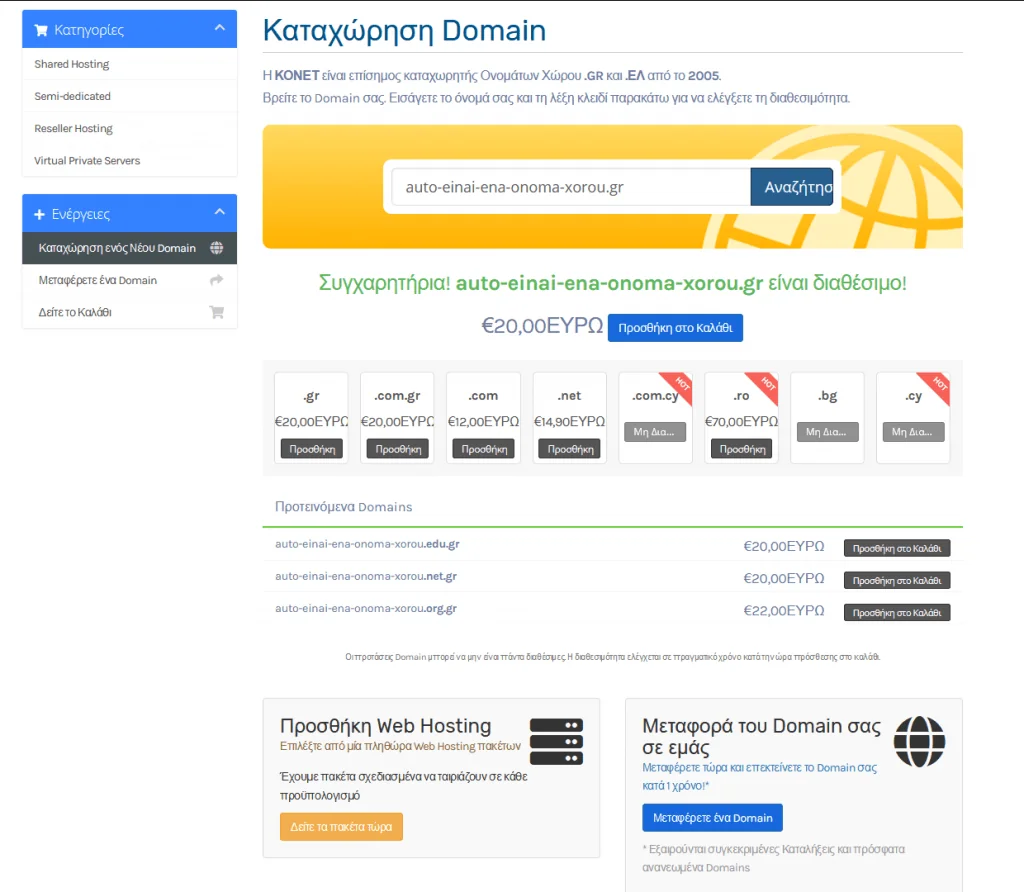
Note that when you buy (that is, register) a domain name, you are actually paying the registrar a yearly or two-yearly fee for it. This subscription ensures that the domain name stays registered in your name.
When the registration period expires and you do not renew it, you lose the domain name, because it becomes available to anyone else who wants to register it.
Fortunately, domain name registrars will send you plenty of emails to let you know that the registration period is about to expire, or they will offer automatic renewal so you do not have to remember it.
Tip: It is always useful to set a reminder in your calendar before the expiry date, so you have time to consider whether you still need the domain name and to renew it in good time.
You would not want someone else to take your domain name, especially if you have been running a website on it for years! So set a reminder somewhere and renew it in good time.
How much does it cost to register a domain name?
In general, a domain name will cost you between 10 – 15 euros a year excluding VAT.
Of course, the price can vary depending on the domain name’s extension and on its registrar.
Tip: The fact that one extension is more expensive than another does not mean it is better. Usually the most common extensions, such as .gr, are the best choice for you.
You can only register a domain name if it is available, that is, if nobody else already has it. Registrars usually let you search whether the domain name you are interested in is available. You will find the whole process, from the availability check to payment, in our guide on how to register a domain name.
Most of the time, though, if you want to use your company’s name as your domain name, it will be available.
Free Domain Name or Buying a Domain Name?
There is a way to get a free domain name, and that is by buying another service together with it.
There are also companies around the world that give away a free subdomain together with other free services. A subdomain is a sub-name of a domain name, that is, it is part of the domain name.
Remember the example domain name example.com that we mentioned above. A subdomain you could get for free from the company Example.com, for example, would be something like:
- konet.example.com
- firstname-lastname.example.com
- your-company-name.example.com
Which domain name your subdomain sits under depends on the company that gives it to you. These subdomains really are given away free for as long as you want.
But a free subdomain is not a good choice.
In general, it is best to avoid using a free subdomain, for 2 main reasons:
- The subdomain does not belong to you. Even though it is free to use, it is not yours. It belongs to the company that provides it. In practice this means that if you want to move the subdomain or the website, you will not be able to. It also means that the company that gave it to you can delete it whenever it likes.
- A subdomain is an extension of the provider company’s domain name. The provider’s name will always appear at the end of it. For example, if we used the company Example.com, our address would be konet.example.com instead of konet.gr .
That is why we always recommend spending a little money to get a proper domain name that belongs fully to you. Among other things, it will also help your branding.
How do Domain Names work?
To understand how domain names work, let’s look at what happens when you use them in your browser.
When you enter a domain name in your web browser, it first sends a request to the worldwide network of servers that together make up the Domain Name System (DNS) .
These servers then look for the name servers associated with the name and forward the request to those name servers.
For example, if your domain name is hosted at Konet, the name servers that DNS will look up will be in the form:
- ns.konet.gr
- ns1.konet.gr
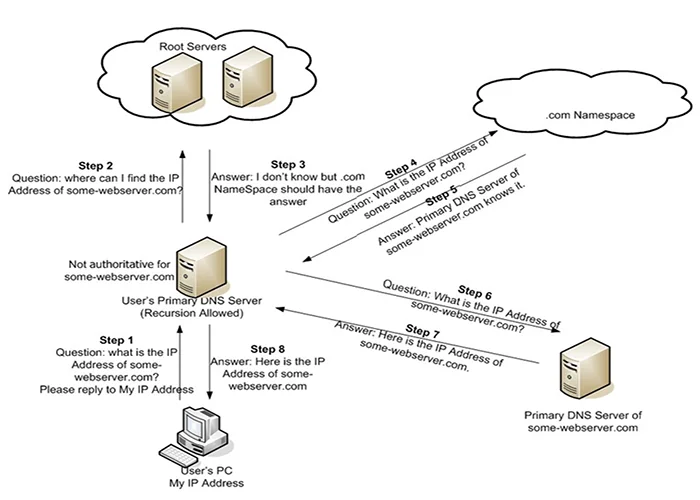
These name servers are computers managed by your hosting company. Once the name servers receive the request, they notify another computer to find the place where your website is stored.
This computer is called a web server. Using the special software installed on it, it looks for your website’s files (two very well-known web server programs are Apache and LiteSpeed). Once it finds your website, it gathers its pieces and puts it together the way it should be.
Finally, it sends this data back to your browser, and that is how you see your website.
Which domain name extension should I choose?
From our experience, most people choose .gr as the extension for their domain name.
Three main factors drive this trend:
- We are in a country where the overwhelming majority of the population speaks Greek.
- Most businesses in Greece mainly target the Greek market.
- The .gr extension is easier for website visitors to remember than other extensions.
Even if you look at it from other angles, the .gr extension is the best possible choice for domain names.
Did you know that the .gr extension offers the highest possible protection of personal data? Only you and the domain name’s registrar can know who your name belongs to. No third party can access this information.
It is also a very affordable choice. By comparison, it is one of the cheapest extensions, with a yearly cost of between 10-15 euros a year excluding VAT.
Frequently asked questions about Domain Names
Over the years we have registered and supported thousands of domain names so they could go online. We have heard countless questions about domain names from their owners.
So below are the answers to some of the most frequent questions about domain names.
What is a subdomain?
A subdomain is essentially a sub-name under the main domain name. For example, blog.konet.gr is a subdomain of konet.gr.
Once you register a domain name, you can create subdomains for it yourself.
Subdomains are mainly used to host sections of websites. For example, we have billing.konet.gr for our Client Area and help.konet.gr for our Help Center. Other businesses may have subdomains such as store.example.com where they run their store.
Can I cancel a domain name registration?
That depends on both the registrar and the domain name’s extension.
Some registrars allow you to cancel a registration. Others do not.
Some registrars refund cancellations, while others do not. Either way, you should read the registrar’s terms of use or contact them to be sure.
Also, with some extensions, once the registration request has been completed it cannot be reversed. For the .gr extension, the window for canceling a registration is 3 days.
If you cancel the domain name registration, it will immediately become available to anyone who wants to register it.
You should know that domain name renewals cannot be canceled.
Can I move my website to another domain name?
Yes, you can. Your website can be connected to any domain name you want. There is no restriction.
Depending on the software your website is built with, moving it to another domain name can be either an easy or a very difficult process.
Ask a technician to tell you how easily the move can be done.
If the move turns out to be difficult, you can find other solutions, which include buying a new domain name and setting up Landing Pages.
What is personal data protection for domain names? Do I need it?
In the past, personal data protection for domain names was very lax. Anyone could look up and find all of the owner’s personal details for domain names with foreign extensions.
To hide them, the owner had to pay an extra amount, usually equal to the cost of registering the domain name.
In recent years the situation has changed somewhat for the better, although there is still room for improvement.
.gr domain names, on the other hand, never had this problem. The owner’s personal data has always been hidden and only the registrar has had access to it.
In our view, it is best if not just anyone can find your personal details. One more reason to choose a domain name with the .gr extension is this extra personal data protection it gives you compared with other extensions.
Can I buy more than one domain name?
Yes, you can buy as many domain names as you want.
Where can I learn about building websites?
Right here. Konet has built a great many websites itself, and also works with experienced, well-established web developers all over Greece.
You can tell us what you need and we will introduce you to the right one completely free of charge! They will tell you everything you need to know about building websites.
We hope this article has helped you learn what a domain name is and how domain names work. You can also read our other articles, which will help you better understand the world of Web Hosting and the internet in general.
Note: Throughout the Greek original of this article we used the everyday word for “securing” a domain name. The correct term is registering a domain name, not securing it. Hence the word registrar.
 This article is licensed under Creative Commons Attribution 4.0 International (CC BY 4.0). You may republish it, provided you credit Konet as the source with a link to this article.